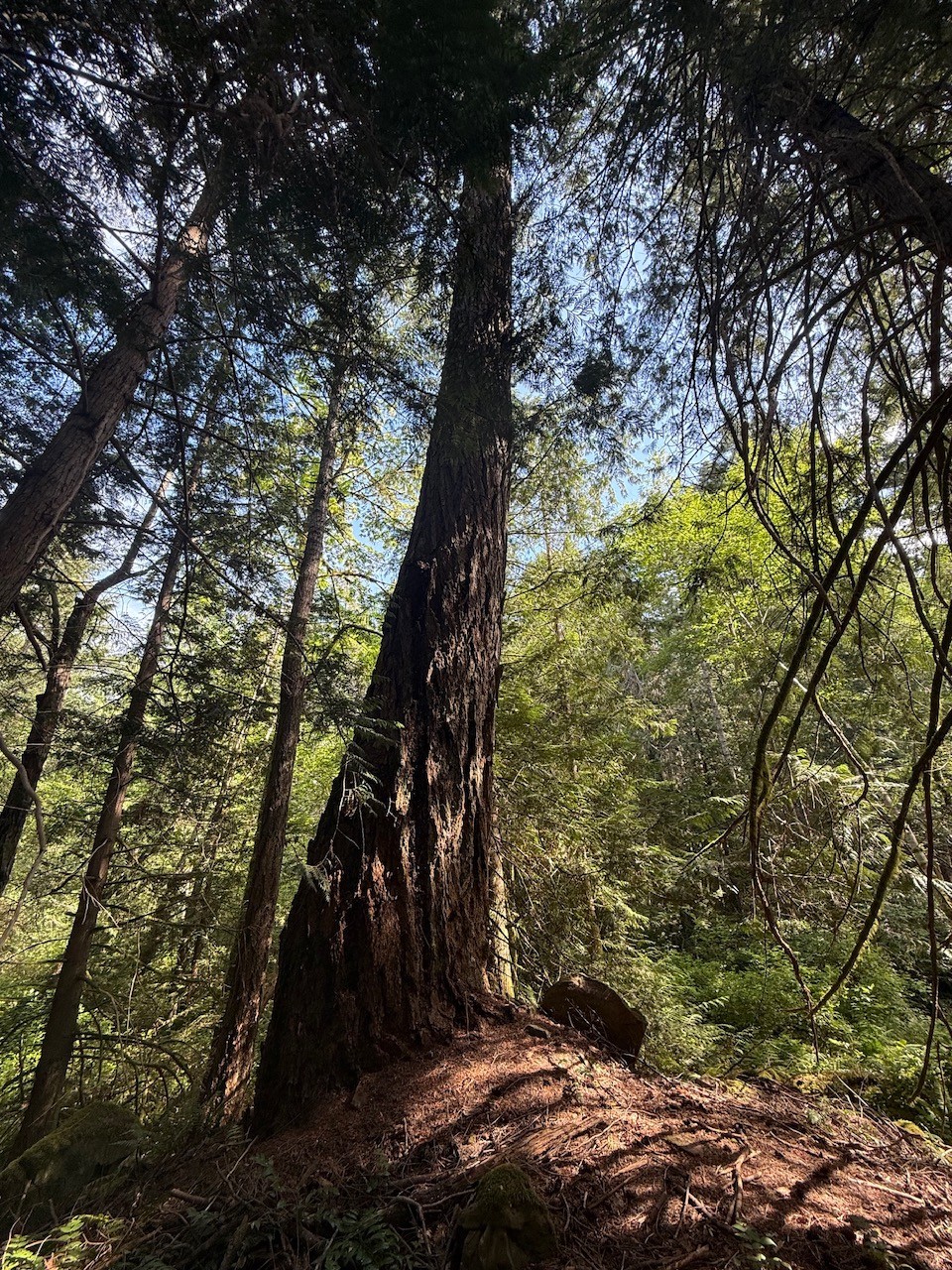
Walk with me through the land that I live on and steward while I write to you about the lessons I have learned from the grandparent tree. I live on Pender Island, or S,DÁYES, which is the traditional SENĆOŦEN name for the Pender Islands, located in the southern Gulf Islands of British Columbia. I chose this place and this way of living because of lessons taught to me by my grandparents, which I carry closely in my heart every day.
My grandparents were incredible people who taught me to steward land, be skillful, slow down, observe my surroundings, care for bees, and take care of my family and community. I value knowledge and ways of knowing from those who have come before me, which includes the land itself. On the land where I live, there is an incredible grandparent tree, an old-growth Douglas fir that is over 500 years old. Like the lessons learned from my grandparents, I acknowledge that this tree has something to teach me about the way I see the world around me. Through the metaphor of the grandparent tree, I will explain how my current work and education in my evaluation program in the School of Public Administration are preparing me to engage with the environmental, geopolitical, and economic polycrisis we are facing in a way that surprises me in its simplicity.
The simplicity is to listen to what I know to be true in my heart: know and care for the land, animals, plants, and people, and they will know and care for you in return.
To be more descriptive, the grandparent tree reminds me about the importance of interconnectedness, relationships, long-term thinking, care for future generations, and the invisible systems connected all around me. These are also the lessons I am learning through evaluation. I am learning that meaningful work does not happen in isolation. It requires attention to context, humility, patience, and the ability to see how one decision or action can affect many other parts of a system.
The grandparent tree teaches me about interconnectedness, relationships, and the invisible systems connected all around me. The roots of the tree are deep and connect with the broader forest ecosystem. In this way, the tree reminds me that what appears individual is never truly separate. This way of thinking connects directly to my work and education in evaluation because I am learning to look beneath the surface of problems. I am learning to ask who is affected, whose knowledge is included, what relationships are being strengthened or damaged, and what consequences may emerge that are not immediately visible. In a time of polycrisis, this way of seeing feels essential because environmental issues, economic instability, political polarization, and social inequity are not separate.
The grandparent tree also teaches me about long-term thinking and slowing down. A tree that has lived for over 500 years does not respond to the world in haste. It has endured changing seasons, storms, droughts, wind, and everything else that has happened around it. The tree steadily reminds me that some forms of wisdom come from patience, observation, and endurance. In my municipal work, I often see how quickly decisions need to be made and how much pressure organizations are under. My education in evaluation is helping me understand the value of slowing down enough to ask better questions before moving too quickly to solutions. It is helping me understand better that complex problems require reflection, evidence, relationships, and care.
The grandparent tree also reminds me of the value of care for future generations. I am aware of where I have come from and who I am as an evaluator, which is something I have recently learned to think about more intentionally through the evaluation program. I am a mother and have been a mother since I was 15 years old, bringing four children into the world and learning from a young age what it means to live with responsibility for both the present and the future. I know that decisions are never only about the immediate moment. They also impact the conditions our children inherit. In the context of polycrisis, this matters deeply to me. Environmental damage, economic instability, political polarization, and social inequity are not abstract issues in my life or my work. These issues are the world my children are living in now and will inherit.
In this way, the grandparent tree helps me understand how my work and education are preparing me to respond to polycrisis. I am not only learning technical skills. I am learning how to listen more carefully, hold complexity, recognize relationships, and think about the long-term effects of decisions. I am learning that evaluation can be a practice of care, responsibility, and collective learning. Like the grandparent tree, I hope to become more deeply rooted, more connected, and more able to support growth, resilience, and renewal around me like my own grandparents taught me long ago.