The Gulf Islands School District and Educational Technology
I teach in the Southern Gulf Islands, which is in the coastal area of British Columbia. The Southern Gulf Islands (SGIs) consist of five islands which are all part of School District 64, the Gulf Islands School District. Some of the islands are more remote and have limited population and infrastructure, such as Saturna Island that has a population of approximately six hundred people. Salt Spring Island is also included in this bunch and is home to just over 10,000 people. The other islands are Pender, Mayne, and Galiano, which are all similarly sized, but with different infrastructure and population counts. Interestingly, the population growth in the Southern Gulf Islands captured in the 2021 census was considerably higher than the national average rate of growth 5.2%, at a rate of 28.9%. This rate was also much higher than the Provincial average of 7.6%. The SGIs are growing and are more than ever a popular place for families to live and work. The child care centre on Pender Island has an ever-growing waitlist, and it is evident that young families are planning to raise children here. The population growth will likely have an impact on the schools in the years to come.

Photo credit: https://hikebiketravel.com/
The number and size of the schools on each island vary, with six located on Salt Spring, and one on each of the other islands. The Gulf Islands School District averages 1500 learners per year in the ten schools.
Students in grades 10, 11, and 12 have the option of travelling by water taxi to Gulf Islands Secondary School on Salt Spring for their formative high school years. The water taxi commute makes a long day for these students who travel 40-60 minutes by boat, twice a day, four days a week to school. The title of my blog, Sea to School, is referencing this commute that I also take as a teacher working on Salt Spring but living on Pender Island. The journey can be picturesque or arduous, depending on the weather, and the water taxis are sometimes cancelled due to stormy seas and high winds. The travel by sea to school is unique in the Gulf Islands and is part of island life that students think about for many years before being old enough for high school.
The Gulf Islands School district, like others, is impacted by educational technology. Educational technology can be defined as the facilitation of learning through use of hardware, software, and educational theory and practice. Educational technology is broadly defined, and has many facets in schools. When reviewing the SD64 Enhancing Student Learning Report from September 2023, many of the suggestions for action relate to educational technology at the district and classroom levels. These vary from having tools of technology in the classroom like computers, use of Power BI dashboards by the HR department, the creation of the online school where I work, in addition to many other references. Clearly, educational technology is an important consideration for current and future high level plans in the school district.
64GO and Educational Technology
Focusing on the school where I work, which is called 64GO, educational technology is part of how the school exists. 64GO is a school focused on online learning, although there is a physical school room located on Salt Spring Island. The school is categorized as a District Online Learning School (DOLS). There is varying enrollment, but there are generally 70-90 students, and the school is in the second year of operation. We have students from kindergarten to adult, and in 2022, there were 88 students enrolled.
As noted, 64GO relies heavily on educational technology of many types as this is an online school. As a school, we use Brightspace to deliver most of the curriculum, a variety of online learning sites, and technology tools in the physical classroom. The classroom for the school is located in a building called the Hub, and allows for a blended learning style for students who want to have an in-person connection with their teachers. The room has computers, iPads, a smart tv, speakers, and a full video meeting set up.
One of the main benefits of 64GO is that students who do not want to travel sea to school can stay on their island and attend school beyond grade 10. There are a few students who are not keen on travel who benefit from studying online in the comfort of their homes. Another benefit of the school is that it supports the goal to enhance district continuing education, as noted in the SD64 Enhancing Student Learning Report. Many adult learners take courses through 64GO to attain their goal of graduation.
Last year, I was part of creating the Epic School Plan for 64GO, along with my teacher colleagues, a parent, and a student at our school. The school is viewed by parents as an alternative to in-class learning which is a benefit for students on the outer islands of Saturna, Mayne, Galiano, and Pender. We also work with families who travel abroad, or for whom attending in person school is not a good fit for their child.
After the first year of implementation at the school, we identified areas of growth that are outlined in the Epic School Plan. One area that I will speak to, as it relates to educational technology, is the delivery of online curriculum. We quickly learned that engagement, motivation, isolation, and at home support were areas of importance. Based on this learning we are looking closely as a school team at the overall intake process, year-long planning for students, and student learning plans as areas of focus for 2023.
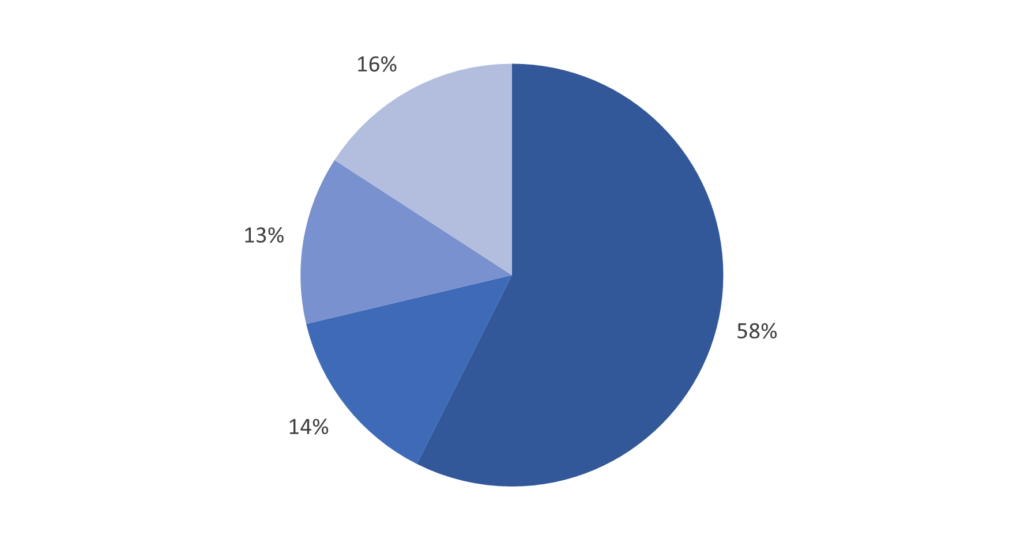
- 58% of students engaged and completed their course or program,
- 14% of students had limited engagement and continued their course or program the following year at 64GO or transferred back to a bricks and mortar school,
- 13% of students engaged and did not complete their course or program; and
- 16% of students registered but never engaged.
As a new online school, we will continue to listen to our learners and use educational technology in many ways to make this possible.
My Classroom and Educational Technology
In my classroom, as a teacher at an online school in a remote area, I collaborate closely with my colleagues to ensure student success as mentioned. We have a small staff team of three part time staff, one principal, and one part time administrative assistant, and rely on each other daily. The Hub has a teacher onsite Mondays and Thursdays. Given that we have a variety of ages and quite a few students, we set up a schedule for students to meet for dedicated time with their teachers. Students are also able to drop in any time during the week to work individually in the quiet and welcoming space. While at the Hub, students have access to computers to use the online platform, a large interactive screen to create art or work on math, and a number of different art supplies, games, toys, and books. The Hub has a welcoming set of couches for families to gather, and for time spent reading with students.
When working at the Hub, my focus is primarily on the students I have coming in to meet with me in person. I also utilize virtual meeting software like Zoom to talk with students who are not able to visit in person on these days. There is time spent troubleshooting how to upload assignments, tutorials on how to use the online platform, and many other rich conversations that happen with students. The Hub is also a wonderful place to use less technology and enjoy a cup of tea or snack together. We also enjoy using less technology when making hands-on art and having social get togethers. Many students also like using pencils and paper to brainstorm ideas, and then complete their assignments on the computer for submission online. This year we are encouraging all assignments to be submitted online in Brightspace, although we do have a paper hand in box available.
As mentioned, I use an online platform to deliver courses and engage with students, and also have the opportunity of working with students in person one day per week. I teach over forty different subjects for ages kindergarten to adult and sometimes never get to meet my students in person. The entire 64GO staff team uses Brightspace which is an LMS software. Starting this September, content for most of the courses comes from StudyForge, a company that creates digital curriculum for Canada and the USA in Math, Science, and Humanities. Some of the courses are created in house by the team at 64GO. As a teacher I continue to learn how to best use Brightspace and the curriculum to meet the needs of my learners, as there are many tools in the software that can make this challenging. Luckily, I have a strong and supportive staff team, as well as students and parents who are engaged and will provide feedback as I continue to learn. As I start on my Masters program in Educational Technology, I am curious and excited to see how I can improve my practice to benefit the learners in my beautiful community of the Southern Gulf Islands.

Photo by Kylie Van Eaton